Monoculture vs Today's Culture

I sort of love the idea of this term that keeps popping up; monoculture. So it's delved into quite a conversation and it's been thrown around just about in every conversation and it's got a lot of valid points here. I am not here to challenge it... but rather to add to it. I've been thinking a lot about this over the years. Obviously things are far different than they were a generation ago; we have social media, political divides like never before, the internet at our fingertips, and everything to feed our egos and dopamine infested minds wherever we go.
Now, I could stand here and make this a huge cultural thing and turn it into this giant conversation, however I don't think that's needed. What is needed, is to simply understand how these things actually form and are created.
This is merely a theory, not fact or even really well researched, but rather a lot of deep thought based on how I've watched humans interact and how things have developed over the years. I've lived through it, I would like to say that I have at least some merit in this conversation.
So for the sake of this conversation, the best thing I know is music (mostly metal). The remainder of the article pretty much focuses on it, but it's not limited to music; it's happened to just about everything.
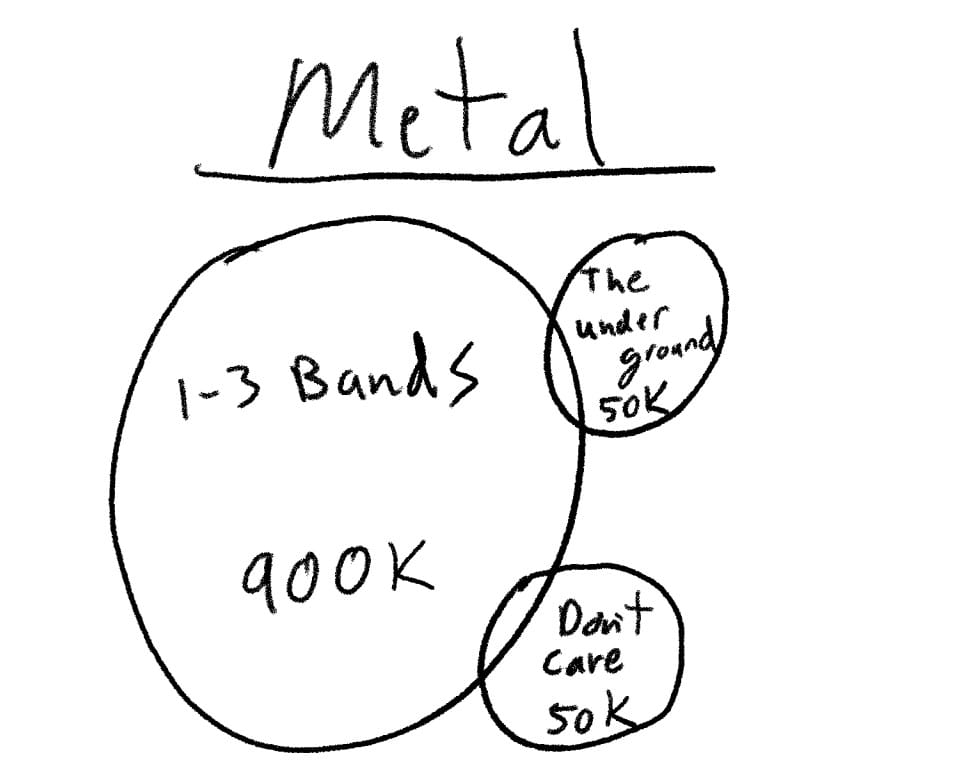
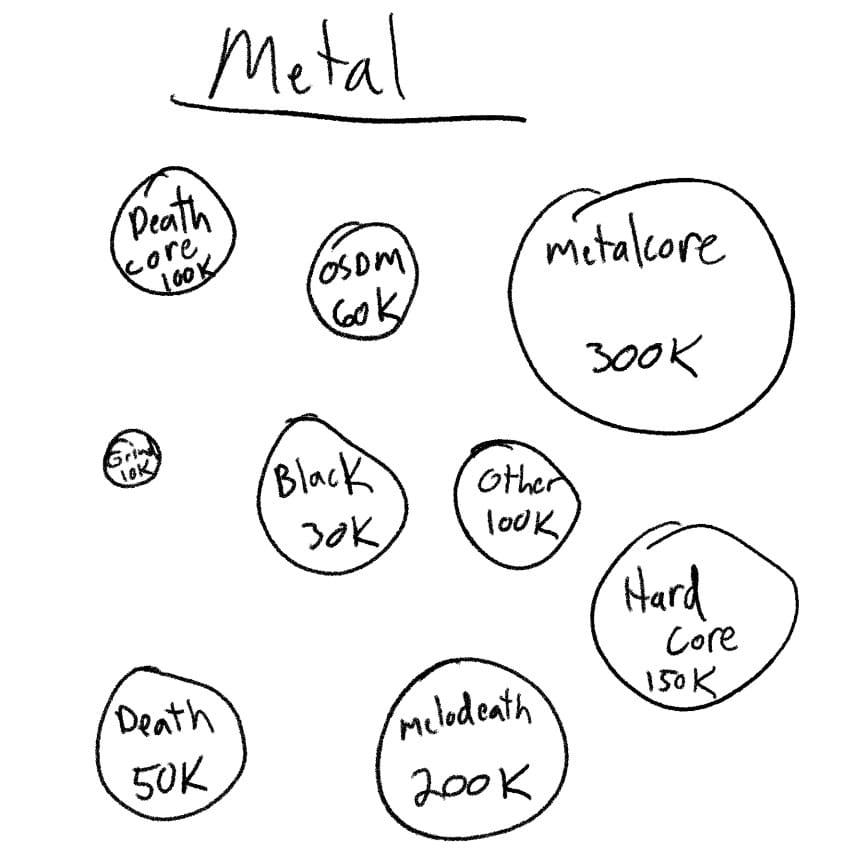
So take a look at the two very, oversimplified examples of the change here. In each picture, pretend there is 1,000,000 (one million) people listening to metal. Here's a few just observations from the above.
| Mono | Multi |
|---|---|
| Less options | More options |
| Defined and known | Siloed and Wild |
| Crossover | Complete separation |
| Audience by Exposure | Audience by Attention |
There's a clear thing you can see from all of that, which is simply that things are far more disconnected than they ever were. This has both it's positives and negatives.
But... that's not what we're here to talk about; no, it's about how it went from one giant bubble with a couple of tiny friends, to a bunch of floating entities out in space. This is my theory in three simple steps;
- Accessibility
- Saturation
- Separation
Oh gosh... I will NOT use the acronym for this one. Let's just call it the 3-Step Process.

Accessibility
Ease to Access
First thing that has to happen for anything to split is that it has to be big enough to split. You can have a bean, but that's really hard to share. If you have a bowl of beans, you can divvy them out.
Instruments and the process of music making/releasing is the first factor in accessibility. If you rewind the clock back about 40 years, it took an act of God or just someone with a siloed focus on music to really get anywhere... and even then, it was still a slim chance you could get anywhere. In today's society, all you need is a laptop, maybe a couple of cheap instruments and equipment, a few plugins (or AI nowadays) and you can make music for all to hear. You don't need big labels, you don't need to "grind it out" and play shows, nothing. You can be completely independent and make music, money, or whatever. With social media being a thing now, you don't need massive marketing teams to shove you everywhere; you can do it yourself.
When we're talking music and listener accessibility, that's where technology gave us all a really cool advancement we like to call streaming. Many consider streaming the death of "true artistry" and a lot of folks complain about payment and all that sorts of stuff... but look, I am not here to vote for corporations. I really have a distaste for the corporatization of everything in life, but sometimes it works in our favor. I won't go into the history, just know you have all the music in your phone now.
Out of all the accessibility enhancements over the years, it created something in today's world that they didn't have way back when.
Choices - The ability to decide what, when, how, where, and why you wanted to listen to music or your preferred media.
The "monoculture" existed due simply to lack of choice. If you wanted to listen to metal, Metallica was the most accessible thing you had. Anything else, you had to tape trade, swap CD's, or oh my gosh... spend money and take a risk on something at the store. When you don't have choices, you just gravitate to what's available and your choice is simple; ignore it or embrace it.
Music, especially metal back then, was just a few beans. We now have vats of beans.

Saturation
The more... the better?
As humans, we see something good, we feel it's good, and then we abuse it to heck and back because we just can't get enough. People who create are inspired, corporations see dollar signs, and people gravitate towards it and we get this massive explosion of that thing; in this case, it's metal music.
Excuse me if I step out of metal for a second and into rock - there was a genre that precedes a lot of our metal scene nowadays; grunge. Nirvana comes onto the scene and threw glam metal into the ocean with bricks on their feet and paved a whole new pathway for the depressed 90's babies and teens. Following in that wave, we got a HOST of bands that fell into that vein; STP, Soundgarden, Pearl Jam, Alice in Chains, etc. and while most of them are iconic stars of the 90's rock and metal scene, it's exactly what I am getting at here - it became highly saturated. All the music and the scene starts to blend together.
As this saturation takes place, you end up in two distinct categories; the embracers of what is here, and the rebels who don't accept what their hearing as the "final form." So in that saturation, we get distinct colors of the genre; what we call "butt rock," nu-metal, emo, etc. and while I call it saturation, we're all used to seeing it as a tree. However, even in the tree, there's cross... there's... saturation.
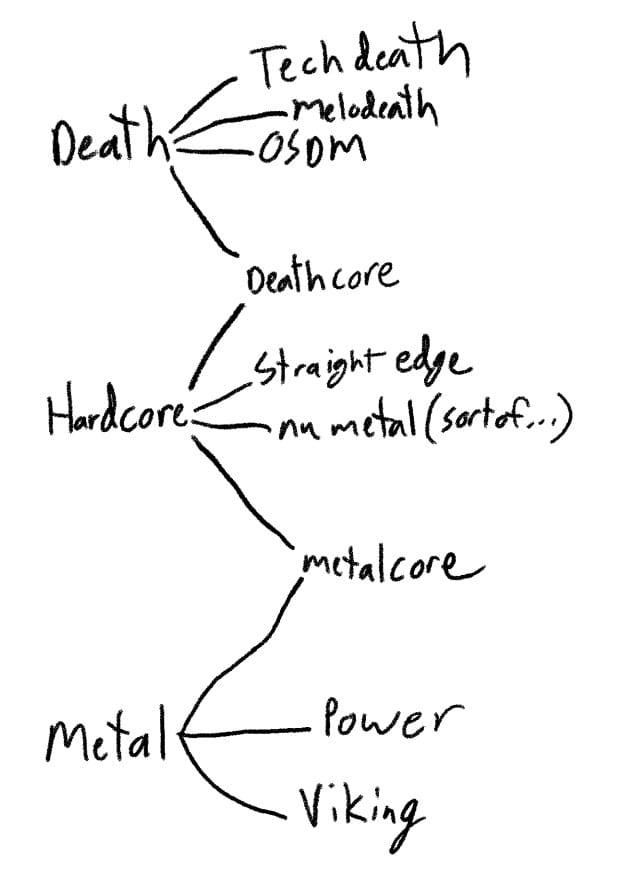
So if accessibility gave us the ability to choose, saturation created the choices. If accessibility gave us the ability to make more, saturation allowed us to develop different sounds with a distinct identity and nature, sometimes even culture.
Separation
The Bubbles Are Blown
We can create infinite things, we can listen to infinite things... well that's a little too much for just about anyone. In a sea of music and oceans of listeners, how in the world do you even find your place in there? Before, we just had a couple of things shoved down our throats. Now we have literally nothing being shoved down our throats, so we look and hunt for the things we want shoved down our throats.
Yeah... I know that was a very poor choice of words, but stick with me.
In the olden days, all it took was exposure... which was limited. We didn't have the internet. We had TV, billboards, the radio, and maybe newspaper and magazines. It costs a lot of money to get there, and when you did, millions upon millions were interested. They kind of had to be, that's all they had to go on.
In today's world... it's attention, and it's so hard to get, and nearly impossible to keep. So instead of developing this attachment and following via things shoved in the limited media you had, all those choices tend to flood you, until something stands out to you in particular. Then it drags you into a little corner. "Oh these 3 bands I like are called deathcore? Cool, I guess that's my crowd," and you join some FB groups and follow a bunch of deathcore pages and you have this little corner of society, this little group. Multiply that by like... I don't know... everything? Suddenly the world has a ton of corners.
In these corners, you exist, move on, or run it dry until the next thing happens to catch your attention.
Not much here - moving on.
The Good and The Bad
No ugly, just some thoughts
I absolutely love choice, especially for the way my brain works. I'd much rather have 10 options, dive into all of them, pick a few I like, and stick forever with 1 rather than just no options. I feel empty. I am also overwhelmed by too many choices and crippled into nothing. Often to escape this, I create choices out of the vastness of what's laid before me to level it out... and sometimes it works.
What I can say about others, is that we all love choices to an extent. However when there's too many choices, we all tend to be separated. Imagine you're at work with 9 coworkers trying to figure out what to do for lunch, but everyone has something different and you can't agree on anything. Eventually, y'all just end up leaving picking up what you want, and returning to work to eat at the same table with different meals. 7 different places, 10 different people, and one of them just bowed out to not eat (usually that one is me) but still sits at the table. Over time what happens is you find a coworker who loves the same restaurants you do who isn't a part of that group, and you end up just sitting at a two seater with them instead of with the 9 other people. Again, more time passes and that group of 9 does the same thing until there are now 20 people, in 12 different groups, all sitting in smaller tables or at different places altogether. Because all the different choices, there's now preferences for food, which creates distance between those original 10 people. Instead of having all this cross department conversation, discovering how people feel about work, the struggles they're experiencing, etc. - you now rarely ever speak to them and everyone lives in their own bubble.
Our media has basically become this. We aren't connecting like we used to because we're all in different places, different groups, different areas of the internet doing our thing instead of as a collective.
The Good
Choice allows us to be more ourselves instead of simply pretending and forcing ourselves to be like everyone else. We don't have that central line of "normalcy" to follow. In addition those choices allow us to choose who we should support, rather than supporting what is fed to us. There's so much benefit and freedom to how accessibility, saturation, and separation creates choices that create these unique subcultures within our world.
The subcultures also are great because it means there's a lot less folks out there that are outcasted. There's a group for you somewhere. There's always a place to call home and really dive into it, make friends, and work with others.
Also, this separated culture allows for far more creative freedom than EVER before. If you don't have a group, you can create one. You don't hear the thing you want, you make it. It's quite a heck of a cool world we live in.
The Bad
Segregated groups also means siloed groups. Not a lot of people are connecting around things they don't have in common like we used to. This ends up in itself creating very distant and divisive natures. We often choose to leave ourselves out and return to our comforts.
What this also means is that we are less unified in a sense that we're all challenging each other. Most of the time a lot of these groups and people you connect to are just stuck in little echo chambers of the sweet nothings you want to hear. We tend to stop exploring and growing, choosing instead to remain in our little bubbles where everything feels nice and safe.
And all of that in turn creates this unrealistic set of "importance" that we place upon ourselves. We often identify with these groups instead of just existing within them. We get validated and loved by those groups so much that everything else feels void, empty, or like an outright attack.
Final Thoughts
What I love most about the "death of the monoculture" is that the corporate grip on it was released a while ago. You no longer have these record labels with a monopoly on entertainment. Do they still exist? Of course, but they are slowly getting severed and cut away over time. What are they to even do? If they cater to all the groups, it's pandering and they suck for it. If they stick to what they know, eventually they'll become irrelevant. If they offer services, it's only a matter of time (if they don't exist already) that independents can use to get the same value without some crazy contract stuff.
The only real value a label provides in today's world is the money and connections for touring. Once that's replaced with management companies that'll give you deals and cost, instead of loans and ownership, these corporate entities will start losing all the legs they stand on, and that's a beautiful thing.
It puts our creativity, our value, our view, our perspective... all back into our hands, which in turns spurs new and exciting landscapes for the future.
Anyway, thanks for hearing me babble and try some new things here. Hope you had fun!


